Limited Time: $50 Off for All Orders Over $500!
Limited Time: $50 Off for All Orders Over $500!

Induction cooktops are often known for fast heating and high power, but maximum wattage is only one part of the cooking experience.
Many everyday cooking tasks actually need the opposite: low, gentle, steady heat.
Think about simmering soup, warming milk, melting chocolate, reducing a sauce, keeping food warm, or slowly cooking delicate ingredients. In these situations, you do not need a sudden burst of high heat—you need the heat to stay low and consistent.
That is where steady low-power heating can make a noticeable difference.
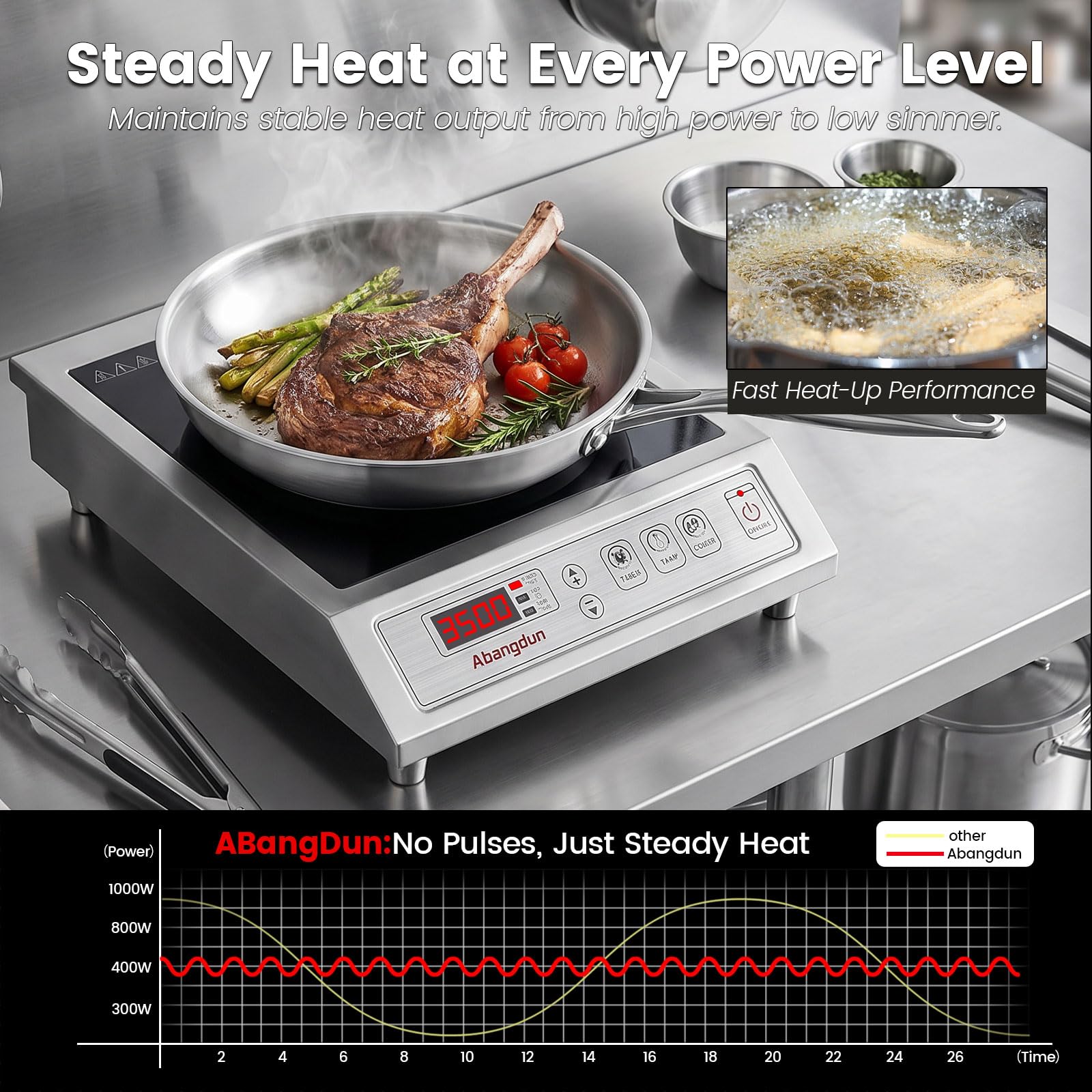
When you set an induction cooktop to 200W, it may seem logical to assume that the cooktop is continuously heating at 200W.
But that is not always how low-power settings work.
On others induction cooktops, the unit cannot continuously operate at such a low output. Instead, it may use a higher power level for a few seconds, turn the heating completely off, and then repeat the cycle.
On Abangdun models designed for steady low-power heating, settings below 500W are delivered at the corresponding low power level. For example, when 200W is selected, the cooktop is designed to keep heating at approximately 200W instead of repeatedly switching between a much higher power level and OFF.
Some induction cooktops create a low average output by cycling between high power and no power:
High Power → OFF → High Power → OFF
Abangdun’s steady low-power design works differently:
200W Setting → Steady 200W Heating
That difference matters when you are cooking foods that respond quickly to changes in heat.
On Abangdun models designed for steady low-power heating, the goal is to reduce noticeable on-and-off cycling at lower wattage settings and provide a smoother supply of heat to the cookware.
Imagine you are simmering a pot of soup.
With cyclic low-power heating, you may notice the soup bubbling strongly for several seconds, then becoming quiet, then bubbling strongly again.
It can look something like:
Boiling → Calming down → Boiling → Calming down
With steadier low-power heating, the cooking process can remain more consistent:
Gentle simmer → Gentle simmer → Gentle simmer
This is especially useful when you do not want large changes in heat.
Foods that can benefit from gentler, steadier heating include:
Milk and dairy products
Chocolate
Butter
Sauces
Soups and broths
Oatmeal and porridge
Braised dishes
Foods being kept warm
Yes.Low power does not mean the cooktop has stopped heating.
If the cooktop continues supplying energy to the cookware, the temperature can continue to rise as long as the heat being added is greater than the heat being lost to the surrounding environment.
Think of it this way:
A high-power setting is like filling a bucket with a large hose.
A low-power setting is like filling it with a smaller stream of water.
The smaller stream fills the bucket more slowly—but it is still adding water.
The same idea applies to heat.
A lower wattage may heat food more slowly, but continuous low-power operation can keep adding energy over time.
Whether water eventually reaches a boil depends on the selected wattage, amount of water, cookware, lid use, and heat loss to the surrounding environment.
Many induction cooktops are compared mainly by their maximum wattage.
It is important when you want to heat quickly.
But real cooking does not stay at maximum power all the time.
Once water is hot, soup is boiling, or a pan reaches cooking temperature, cooks often turn the heat down.
That is why Abangdun also focuses on what happens at the lower end of the power range.
On models designed with steady low-power heating, the system helps reduce noticeable heating pauses and provides smoother energy delivery for your cooking tasks.

